
Woven
January 20 – February 27, 2026
161 Water Street, Suite 2703, New York, NY
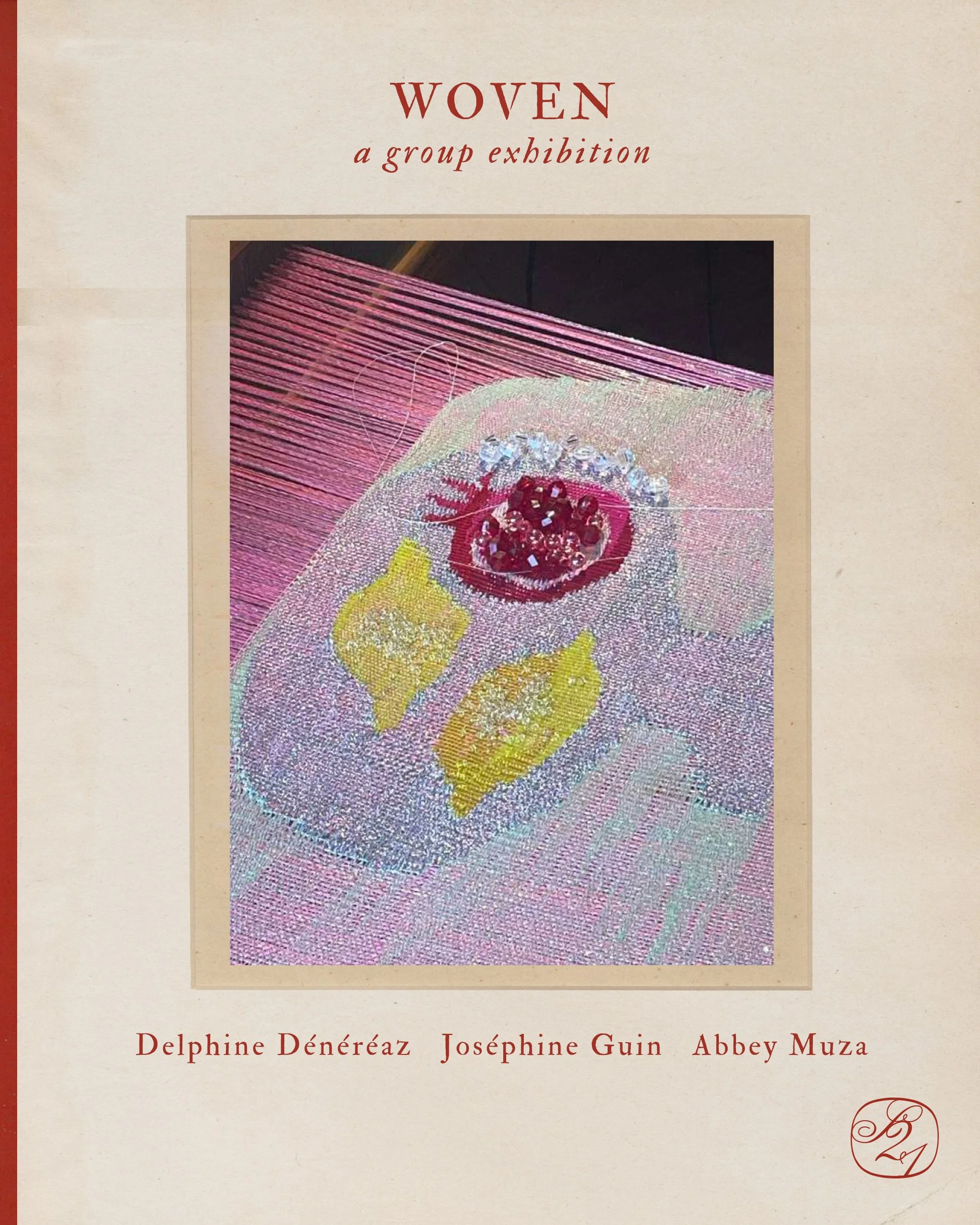
Salon 21 is pleased to present “Woven,” a group exhibition of three textile-based artists who explore the intersections of gender, womanhood, and the politics of craft. Through weaving, embroidery and tapestry, each artist reclaims textile work, once dismissed as mere “women’s work”, and elevates it into powerful contemporary art, loaded with history, memory, and political resonance.
About the Artists
-
Delphine Dénéréaz lives and works in Villedieu, in the Vaucluse region of France. She is an artist-in- residence at Atelier Vé (Marseille). After graduating in Textile Design (La Cambre), she turned to Fiber Art, appropriating a traditional medieval technique: tapestry weaving. By adapting this method to metal or wood supports, she transcends the limitations of the tool and elevates tapestry beyond a purely decorative framework. At the crossroads of craftsmanship and magic, her vibrantly colored works draw upon ancestral and folk knowledge. Working in lirette, a traditional technique that she liberates from its utilitarian roots, Dénéréaz collapses the boundaries between domestic craft and public art. Her work celebrates femininity while also challenging its traditional constraints—infusing traditionally “feminine” forms with references to sport, humor, and street life. Ethical and aesthetic, her tapestries are created entirely from textile waste, underscoring a sustainable ethos that aligns care for materials with care for community and the planet.
-
Joséphine Guin is a Marseille-based textile artist and weaver. After her studies in textile arts à Duperré and Olivier de Serres schools in Paris, she developed a weaving practice that moves between art, design and craft. Her approach resonates with traditions that compare the weft thread to a soul inscribed in matter. The act of creating a textile is akin to writing a diary, and weaving becomes an extension of the weaver herself. With her beaded, embroidered “woven interiors,” she turns everyday objects into precious still lifes, miniature altars to domesticity. Her works evoke familial intimacy, childhood recollection, and the quietly monumental presence of the feminine domestic space. In Guin’s hands, the decorative becomes deeply political: these tiny, jeweled pieces elevate the mundane and memory-laden objects of the home to artworks imbued with reverence. They suggest that domestic labor, care, and emotional memory are not only worthy subjects of art—but are, in fact, the stuff of art itself.
-
Abbey Muza is a Philadelphia-based artist whose woven textiles act as both surfaces and thresholds. Inspired by queer archives and feminist theory—particularly Monique Wittig’s radical text Le Corps Lesbien—Muza’s weavings and text drawings destabilize conventional ways of reading both language and the body. Their pointillist tapestries, composed of intricate threads, interrupt their own structures with fragmented images of the artist’s body, dissolving boundaries between text and textile, intimacy and abstraction. By treating language as tactile and threads as linguistic, Muza offers a complex, sensorial reflection on queerness and the instability of fixed identity—both corporeal and textual. They hold a BFA from the School of the Art Institute of Chicago and their MFA from the Tyler School of Art and Architecture.
